Tuesday, March 30, 2010

Tuesday, March 30

Yesterday, Monday March 29th, Bharat dropped me off at my cousin (from my mother’s side) Ranjan’s house. My uncle & cousin Jayshree came on a one-hour train ride from Viramgam to Ahmedabad to Ranjan’s house to see me. My other cousins (Ranjan’s sisters) Anju & Shilpa, and their husbands were also there. It was so good to see everyone. And of course we had a huge lunch, eating traditional Indian style, sitting on the floor & eating with our hands. The only cousins I didn’t see from this group were Hershida (who lives in Mumbai), and Ashwin & Manish (who run the shop in Viramgam with my uncle, selling spices, flours, and grains). The shop has been in their family for 78 years.

After a delicious dinner of a South Indian favorite of mine, uttapum with coconut chutney, at Dipika & Bharat’s, I was off to see another cousin, Sucheta (from my father’s side) where I stayed the night. Today we went to visit the hospital where I was born, then to the school where my cousin (Sucheta’s brother) Dharmesh goes. Sucheta drove me around on her scooter, and I apparently tried to get on before she was ready for me to, and we both fell hard on the concrete pavement, along with the scooter. My right side is very sore, but we were lucky it didn’t happen while we were driving in traffic. An interesting side note: a lot of women cover their faces & heads with a scarf when they ride scooters, to protect themselves from the pollution & the heat, which is intense in the afternoons.

Sucheta dropped me off at yet another cousin’s house, Suresh (on my mother’s side) where Suresh’s sister Bhavana & her husband came to see me. Then in the evening, it was off to Dipika’s sister Aruna’s house in the outlying town of Naroda. We had a huge dinner there & watched cricket on TV.

Tomorrow we’ll go see Dipika & Bharat’s farmhouse, then it will be time to pack up & head to the airport for my 9 PM flight (Ahmedabad to Mumbai to Amserdam to NYC to Rochester, which is about 20 hours of flying time, not counting layovers). It’s been wonderful seeing my family, although there wasn’t enough time to see everyone. Looking forward to getting home. It will seem cold compared to the blistering heat here.
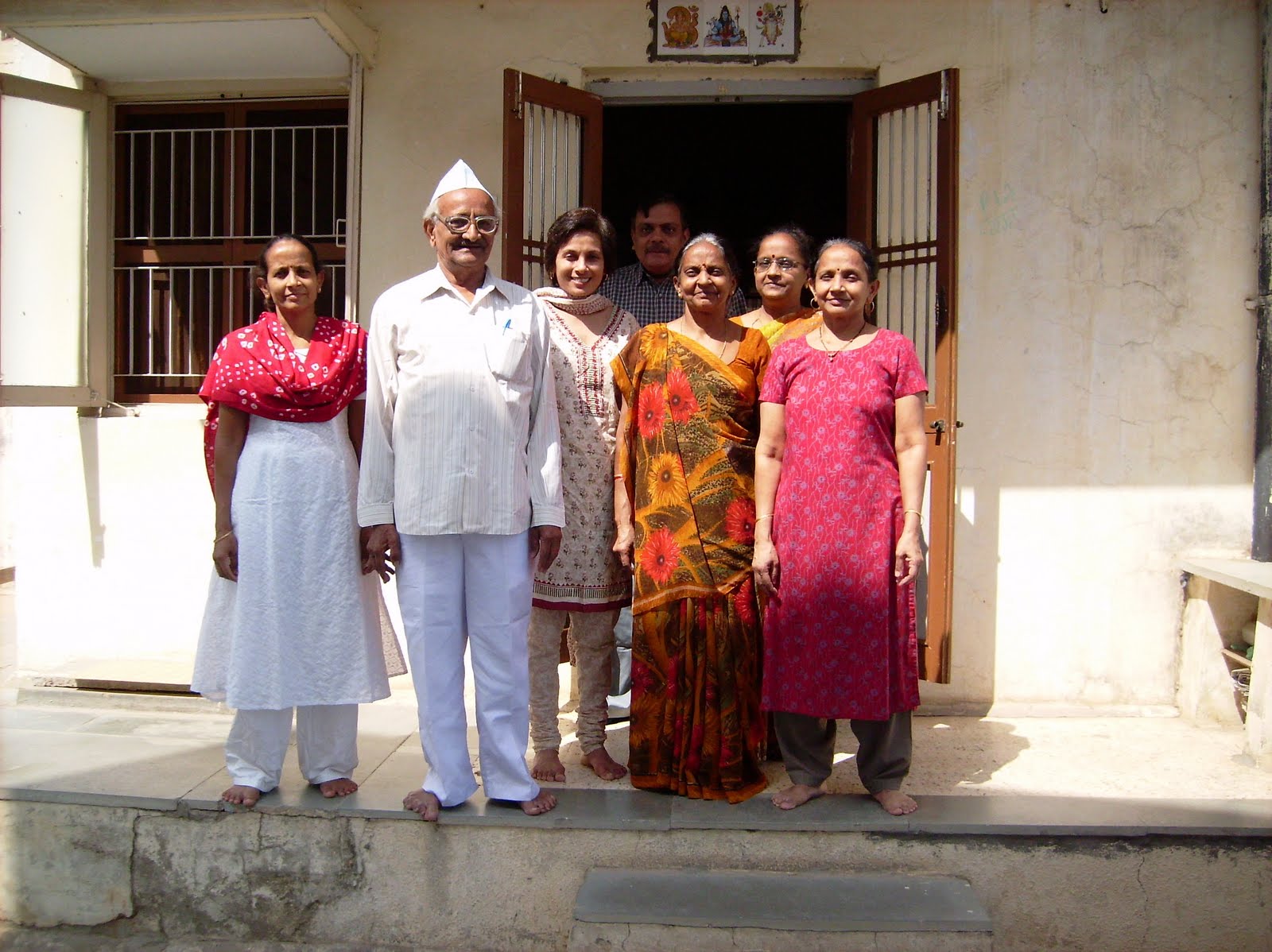

From left, Jayshree, my uncle, me (I went native), Shilpa's husband in the back, Ranjan, Shilpa, and Anju


Elephant on the highway.


Sucheta & I by her scooter (the one we fell off of)

Monday, March 29, 2010

Sunday, March 28

“The best way to find yourself is by losing yourself in the service of others”
“Hands that help are holier than lips that pray”


These are some of the premises of a wonderful place called the Seva Café on the rooftop of a building in the busy shopping district of Ahmedabad, that I went to tonight with my cousins Sucheta & Dharmesh. Seva means service, and the Seva Café, which is run entirely by volunteers who do the cooking & cleaning, serves a delicious dinner at no charge. At the end of the dinner, the patrons can contribute as much as they like, with proceeds going to fund different projects to help the needy in Ahmedabad. There is also a shop consisting of crafts & clothing made by the poor, which allows them to showcase their work & make a living.

I have been staying with my cousin Dipika & her husband Bharat since I got in to Ahmedabad on Friday night. I’m taking a few days PTO to visit my family before flying back home on Wednesday. My mother had 2 sisters & 2 brothers, and my father had 2 brothers, and most of them had large families, so I have many cousins, who have children, and many of them are grown & married with children of their own. The in-laws are also part of the extended family, so it’s easy to see why weddings are so big (Dipika & Bharat’s son was married in February & they had 600 people at the reception!). I won’t have time to visit everyone before Wednesday, but I’d like to see as many of them as I can. And it’s nice to be able to communicate with everyone since I speak Gujarati pretty well – which has surprised some people. I can even read some of the signs.

Another cousin Naina (Dipika’s sister) & her daughter Disha, had picked me up this morning, and I went to their house where I had a huge lunch. Sucheta & Dharmesh picked me at Naina’s house (we went to their house in a rickshaw), and I spent the evening with them. I had some fruit at their house called chicku – they don’t sell it in the U.S. unfortunately. It’s like kiwi, but brown on the inside as well, sweet, and without the seeds. There is a chicku tree at Sucheta’s house. I remember eating a lot of chickus & mangoes when I lived in India as a child.

The purpose of this trip being about water, I had to find out how my cousins get their water. The municipal water is turned on two hours a day, in the morning, and each house has water storage tanks that are filled up. Water is used from those tanks until the next day, when the water supply is replenished. As in Lucknow, every house I’ve been to has a water purifier system for the drinking water. Dipika & Bharat carry around their purified water in plastic bottles when leaving home, just to be safe.

When we were driving from the Vadodara Airport to the hotel last Friday, I had noticed how smooth the roads were & the streets weren’t as crowded as Lucknow. Gujarat has the fastest growing economy in India, and it is evident in Ahmedabad, where there has been a lot of growth in the last few years, with high-rise apartment buildings, shopping malls, and highways (overpasses are called fly-overs); the roads even have signs! There is still poverty & the city is still crowded by U.S. standards, but it doesn’t have the crushing poverty & over-population of U.P.


Dipika & Bharat in their house.


From left, Dharmesh, Disha (behind me), Naina, Sucheta, Disha & Jitesh's son Tanay, held by his Dad Jitesh


Arriving at Sucheta's house in the rickshaw.


The Seva Cafe.

Friday, March 26, 2010

Friday, March 26

The five of us that stayed at the Welcom Hotel in Vadodara met for breakfast this morning, then we headed off to the ITT India plant,where we met up with the rest of the volunteers who drove in from Ahmedabad. Malove Pandya, who works at the ITT plant in Vadodara, and was teamed with Vikram Nanwani (from Sweden) for Gujarat state for the scoping study, organized our transportation arrangements, meeting room, refreshments & lunch. The ITT India plant (we got a tour), which produces pumps, is an impressive facility that is only two years old.

It was great to meet the rest of the volunteers in person – it seemed like we already knew each other. After the initial introductions, with Jim as our facilitation, all of the teams shared their experiences and challenges. After a delicious Indian lunch in the canteen, and me as the note-keeper, we had an open, lengthy discussion on lessons learned, things that went well, and suggestions for improvement. It’s hard to believe that we are done with the India scoping study assignment (athough most of us still have to complete the report after we get back home). It’s been a life-changing experience, and something we are all grateful to have been a part of.

Some of the team is headed home tonight, and some leave tomorrow. I rode to Ahmedabad with Paula and Vikram where my cousin picked me up. He said it’s been very hot here, about 115 degrees F a few days ago, but is not quite as hot now. After dinner & watching a cricket match (Rajasthan Rangers & Deccan Chargers) on TV, I am ready to get some sleep. I will be staying here a few days to see my family.

Our team in front of the ITT India facility.

Thursday, March 25, 2010

Thursday, March 25

What a hectic day. After taking an early walk around the neighborhood, we packed up, checked out & headed to UNICEF for a meeting with Mr. Amit Mehrotra of UNICEF. Mr. Mehrotra is the Water & Environmental Sanitation Specialist, and he had a lot of great information to share. He shared some studies with us that were done by UNICEF on contamination of water supplies, and on hygiene behaviors. He said bacterial contamination of water sources is a huge problem, and hasn’t received much attention. We will be contacting him to get additional information, since he is working in the same areas as WFP.

We dashed off to the airport for our trip from Lucknow to Vadodara, Gujarat (via Mumbai) for our team meeting tomorrow & a tour of the ITT facility. At the hotel, we ran into several of the other volunteers, who we thought were staying in Ahmedabad – Nikki, Debra, and Paul. It was nice to meet other team members in person, and we look forward to meeting everyone else tomorrow, and sharing our experiences. After the meeting, some team members are flying home, and a few others are leaving Saturday. I will be staying a few days to visit my family in Ahmedabad, and will try to update the blog when I get a chance.

Public toilet near the hotel.


Streets are quiet in the morning.


The hotel staff gathered to say goodbye. The woman on the right in the orange & red sari is named Sharmila too!

Wednesday, March 24, 2010

Wednesday, March 24

Today is the birthday of the Hindu God Lord Rama (an incarnation of Lord Vishnu), and an Indian holiday, called Ram Navmi. Rama’s birth place & home is in Ayodhya, in the district of Faizabad, UP (about 135 km east of Lucknow). This ancient Hindu holy city is described in the epic poem, the Ramayana, which tells the story of Rama and his battle against the demon king Ravana, who abducts Lord Rama’s wife Sita. Hindu temples all across the country, and especially in Ayodhya, had special ceremonies to commemorate the occasion.

We spent most of today working on the interview summaries and the report, although there is still quite a bit of work left on the report, which we will complete from our U.S. homes. Mr. Ojha from the Bio Energy Mission Cell at the Department of Planning (we first met with him on Monday, March 22) came by to talk to us and give us some documents on a study on drinking water quality standards, and a Government of India Program called the Rural Sanitation Campaign.

Mr. Aditya Vidyasagar of the Bora Institute (we went to the school on Friday, March 19) invited Jim & I to dinner with his family at a restaurant serving Lucknow specialities, and also to give us a documents on ground water management, and information on water challenges & potential solutions. He is very active in social causes, and is enthusiastic about spreading his message on improving communications and making communities active participants & stakeholders in managing their water resources. Dinner was late, due to the family going to the temple before dinner for Ram Navmi (it was also Mr. Vidyasagar's birthday), but very enjoyable.

Today was our last full day in Lucknow. Tomorrow will be a hectic day. After checking out of the hotel, we have a meeting at UNICEF, then head to the airport for our flight to Vadodara, Gujarat (via Mumbai) where we will tour the ITT facility on Friday and have a group meeting with all of the teams.

Dinner with Mr. Vidyasagar & his family.


This is why there's so much noise. The backs of rickshaws & buses say "Blow Horn" or "Horn Please" like this one.


One of many shops along the street selling food. As delicious as it looked & smelled, we didn't get any.

Tuesday, March 23, 2010

Tuesday, March 23

Our first meeting was at Oxfam India. Actually we didn’t have a contact name there, so we just showed up – that seems to work pretty well. We have a different driver, one that speaks a few more words of English, and he is much better at finding the offices. Some of the buildings & houses have numbers on them, but many offices don’t have signs out front, and I haven’t seen a single street sign. Inevitably, the driver has to get out, sometimes several times, and ask people where the office is. It is a challenge finding these locations.

We met with Ravi Singh, who is the Finance Officer, and has worked for Oxfam for 11 years in different parts of India. He talked about some of Oxfam’s programs – their biggest one is livelihood, where they provide support for agricultural programs. They are also working on programs for ending violence against women, women farmer campaign (so Indian women can have land in their names), and education for the lowest caste girls (dalits). Oxfam partners with other NGOs to provide emergency relief, including clean water & sanitation. Mr. Singh talked about the challenges of working with many other partners, and how Oxfam conducts financial monitoring of the other agencies because some of them aren’t good at reporting & planning. He gave us several documents, including an Annual Report, Newsletter, and a report on Oxfam’s mission.

Several of our contacts have mentioned that working with school children is a very effective way of changing attitudes & mindsets on the importance of clean water & proper hygiene practices, and that we should talk to someone in the Department of Education. We had a contact name from one of our interviews earlier, so we headed off to find this person. After finding the place, and a comical exercise in going up 3 flights of stairs, then down the stairs to another building, then back to the first building & up the 3 flights of stairs again, we talked to Mr. Ashok Ganguly, whose business card states is the “Additional State Project Director”. Mr. Ganguly talked about the number of schools in UP, and how the rural areas especially need water & sanitation help, and separate toilets for girls & boys. He suggested WFP could start in UP with several schools for underprivileged girls. The Director wasn’t there, but Mr. Ganguly was going to set up a meeting with him for later in the evening, but he never did call.

Statue of the Chief Minister of UP, Mayawati & the Governor, Shri B.L. Joshi. Their pictures, especially of Mayawati, are plastered all over Lucknow.


One of many hand pumps all around Lucknow. There is a public toilet in the pink building behind the hand pump.


Lucknow Convention Center

Monday, March 22, 2010

Sunday March 21 & Monday March 22

Yesterday, Sunday, March 21, we traveled north of Lucknow (written as लखनऊ in Hindi) to see the landscape & the Buddha Resort in Bahraich where we had lunch. In between passing through villages jam-packed with people, shops, vehicles & animals, there are open fields, grass & trees, the Gangahar river, and smaller rivers that eventually flow into the Ganges.

Kids playing in the river, and cattle grazing.


This cow was trying to lick my face.


We saw many facilities for building bricks and women harvesting crops, including mustard seeds. The majority of the state’s population depends on agricultural activities, and we saw evidence of that in our drive, with people herding cattle & goats, farming & harvesting. The villages were selling a lot of sugarcane, grains, and fruits. We also saw many hand pumps in the villages & people getting water, bathing, washing clothes, and filling up containers.

At the end of this post, there is a 4 minute video that Jim took of one of the villages as we drove through, which will paint a better picture of what it’s like with the crowds & noise. As is the case with other major cities in India, in addition to the many villages that are like what you see & hear in the video clip, Lucknow has major highways & roads, gardens & parks, and beautiful monuments and buildings. The major intersections have roundabouts and major streets have traffic lights, although no one seems to follow them & cars just go through red lights.

The Parliament Building of UP


Monday, March 22, is World Water Day, and another blazing hot day in UP. We met with Mr. P.S. Ojha, who is the State Coordinator for the Bio Energy Mission Cell in the Department of Planning for the Government of UP. Security was the tightest we’ve experienced of any of the offices we’ve visited; we had to get a picture ID and be escorted to see him. Mr. Ojha’s organization is active at the grass-roots level on bio-energy, and is focused on biological sources such as human, cattle, and horticultural waste. He gave us a DVD containing a documentary on a project they worked with UNICEF on for converting waste to organic fertilizer. He also mentioned a project that a U.S. group proposed to treat sewage water for irrigation purposes; this water can be further treated & purified to be used for drinking water. Mr. Ojha is going to coordinate a joint meeting with other government agencies including the Jal Nigam, for Wednesday.

Rest of the day was spent catching up on documenting notes and sending follow-up e-mails.